About the
Montréal Declaration on Responsible AI
An initiative of Université de Montréal
Context
On November 3, 2017, the Université de Montréal launched the co-construction process for the Montréal Declaration for a Responsible Development of Artificial Intelligence (Montréal Declaration) . A year later, the results of these citizen deliberations are public. Dozens of events were organized to stimulate discussion on social issues that arise with artificial intelligence (AI), and 15 deliberation workshops were held over three months, involving over 500 citizens, experts and stakeholders from all backgrounds.
The Montréal Declaration is a collective work that aims to put AI development at the service of the well-being of all people, and to guide social change by developing recommendations with strong democratic legitimacy.
The selected citizen co-construction method is based on a preliminary declaration of general ethical principles structured around seven (7) fundamental values: well-being, autonomy, justice, privacy, knowledge, democracy and responsibility. Following the process, the Declaration was enriched and now presents 10 principles based on the following values: well-being, autonomy, intimacy and privacy, solidarity, democracy, equity, inclusion, caution, responsibility and environmental sustainability.
Our process for responsible artificial intelligence
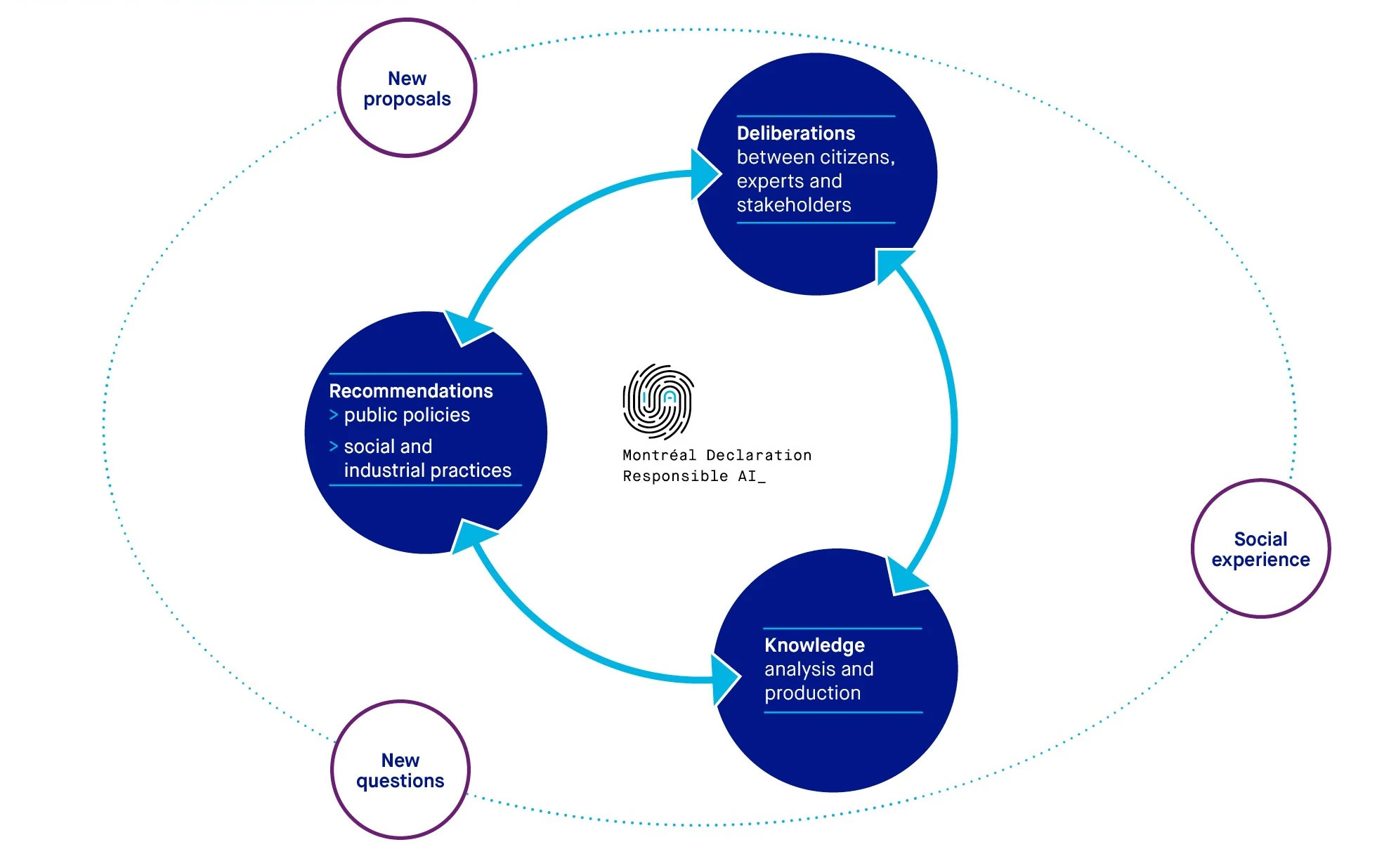
The Montreal Declaration for a Responsible Development of Artificial Intelligence is based on a declaration of ethical principles built around 7 core values: well-being, autonomy, justice, privacy, knowledge, democracy and responsibility. These values, suggested by a group of ethics, law, public policy and artificial intelligence experts, have been informed by a deliberation process. This deliberation occurred through consultations held over three months, in 15 different public spaces, and sparked exchanges between over 500 citizens, experts and stakeholders from every horizon.
Co-construction
Expert perspective and citizen experience
for an ethical development of AI
The deliberation - Exposing, Debating, Suggesting
Exposing
Educational, ethical and methodological introduction
What is artificial intelligence? What are the ethical issues raised by AI? What is co-construction, and most importantly, what is expected of citizens? The scientific co-directors of the Declaration answer these questions and set the stage for the ensuing discussions.
Debating
Group discussions on AI issues
Education, Health, Smart Cities, Justice and the Workforce are the 5 sectors around which prospective scenarios were developed. Using these scenarios set in 2025, groups of 5 to 8 people, with the help of a facilitator, discuss ethical issues.
Suggesting
From ethical issues to suggestions
Using the issues developed for 2025, participants must now imagine recommendations to allow a responsible rollout and use of AI in Quebec.
Education
At one of the tables discussing education, there was talk surrounding a 2025 elementary class where AlterEgo, an AI that assists teachers, can detect children with learning disabilities and even make teaching recommendations.
Excerpt from the debate
How long has data on the students been collected? Who has access to this data? Will the child have to live with “his profile” throughout his entire life as a student? The risk of discrimination is very real.
Example of a proposal
selected by the group
Everyone must understand the consequences of using data: professionals, students and parents alike. Digital literacy training is crucial.
Smart City
One of the scenarios under the Smart City theme led to a discussion around a couple owning an appliance that prepares the week’s menu and is connected to a smart refrigerator, as well as their watches and cellphones. The data concerning their sleep, energy expenditure, amount of fat consumed, is all recorded and sent to … their health insurance provider.
Excerpt from the debate
Useful for a busy life. But the day the family decides to have burgers and fries, do their insurance premiums go up? Can the consumption data be sent to companies? Are we independent when it comes to our so-called “healthy” choices?
Example of a proposal
selected by the group
The Consumer Protection Act should be updated and overhauled to avoid any conflict of interests. We must ensure that the use of data is transparent, and the user must have the right to configure connected objects.
Health
At one of the tables focused on health, we discussed the case of Soline, an elderly lady kept at home thanks to her robot Vigilo. This AI monitors the evolution of the patient’s dementia, prepares her pills and can even hold a conversation with her. Her family can check every interaction and every element of data at any time, which is very reassuring for them.
Excerpt from the debate
Staying at home is a priority for the patient and a plus for the healthcare system. But does entrusting a robot with her care mean that family and medical personnel are no longer responsible? And does the patient really want her family to know everything about her?
Example of a proposal
selected by the group
Research programs should foster the development of open source algorithms to lower costs, increase transparency and encourage sharing. A good way to avoid social and regional discrimination.
Declaration Development Committee
Leader
Marc-Antoine Dilhac
Scientific Co-director of the Declaration, Full Professor, Department of Philosophy, UdeM, Chair of the Ethics and Politics Group, Centre de recherche en éthique (CRÉ), Canada Research Chair in Public Ethics and Political Theory
Isabelle Bayard
Vice-Rector assistant of Reasearch, Discovery, Creation and Innovation, Université de Montréal
Joliane Grandmont-Benoit
Project Coordinator, Vice-rectorate of Student and Academic Affairs, Université de Montréal
Anne-Marie Savoie
Adviser, Vice-Rectorate of Reasearch, Discovery, Creation and Innovation, Université de Montréal
Nathalie Voarino
Scientific Coordinator, PhD Candidate in Bioethics of Université de Montréal
Christophe Abrassart
Scientific Co-director of the Declaration, professor in the School of design and Co-director of Lab Ville Prospective of the Faculty of Planning of the Université de Montréal, member of Centre de recherche en éthique (CRÉ)
Yoshua Bengio
Full Professor of the Department of Computer Science and Operations Research, UdeM, Scientific Director of MILA and IVADO
Guillaume Chicoisne
Scientific Programs Director, IVADO
Marc-Antoine Dilhac
Scientific Co-director of the Declaration, Full Professor, Department of Philosophy, UdeM, Chair of the Ethics and Politics Group, Centre de recherche en éthique (CRÉ), Canada Research Chair in Public Ethics and Political Theory
Sébastien Gambs
Professor of Computer Science of Université du Québec à Montréal, Canada Research Chair in Privacy-Preserving and Ethical Analysis of Big Data
Vincent Gautrais
Full Professor, Faculty of Law, Université de Montréal; Director of the Centre de recherche en droit public (CRDP); Chairholder of the L.R. Wilson Chair in Information Technology and E-Commerce Law
Martin Gibert
Ethics Counsellor at IVADO and researcher in Centre de recherche en éthique (CRÉ)
Lyse Langlois
Full Professor and Vice-Dean of the Faculty of Social Science; Director of the Institut d’éthique appliquée (IDÉA) ; Researcher Interuniversity Research Centre on Globalization and Work (CRIMT)
Pascale Lehoux
Full Professor at the School of Public Health of University of Montreal (ESPUM); Chair on Responsible Innovation in Health
Jocelyn Maclure
Full Professor of philosophy, Université Laval and President of the Quebec Ethics in Science and Technology Commission (CEST)
Joëlle Pineau
Associate Professor and William Dawson Scholar, McGill University; Director of Facebook AI Lab in Montréal; Co-director of the Reasoning and Learning Lab
Peter Railton
Professor of philosophy, University of Michigan
Catherine Régis
Associate professor, Faculty of Law, Université de Montréal; Chairholder, Canada Research Chair in Collaborative Culture in Health Law and Policy; Regular researcher, Centre de recherche en droit public (CRDP)
Christine Tappolet
Full Professor, Department of Philosophy, UdeM, Director of Centre de recherché en éthique (CRÉ)
Esma Aimeur
Full Professor of the Department of Computer Science and Operations Research, UdeM
Sylvain Bédard
Patient Coordinator at Centre of Excellence on Partnership with Patients and the Public (CEPPP)
Louise Béliveau
Vice-Rector of Student and Academic Affairs, Université de Montréal
Hugues Bersini
Professor in Université Libre de Bruxelles and Co-Director of the IRIDIA laboratory
David Décary-Hétu
Assistant Professor, School of Criminology, Université de Montréal; Regular researcher at Centre international de criminologie comparée
Pierre-Luc Déziel
Professor, Faculty of Law, Université Laval
Benoit Dupont
Full Professor in the School of Criminology, Université de Montréal; Canada Research Chair in Cybersecurity; Scientific Director of the Smart Cybersecurity Network
Vincent Gautrais
Full Professor, Faculty of Law, Université de Montréal; Director of the Centre de recherche en droit public (CRDP); Chairholder of the L.R. Wilson Chair in Information Technology and E-Commerce Law
Thierry Karsenti
Full Professor, Faculty of Education, Université de Montréal; Chairholder of the Canada Research Chair on information and communication technologies in education
Jihane Lamouri
Diversity Coordinator, IVADO
Pascale Lehoux
Full Professor at the School of Public Health of University of Montreal (ESPUM); Chair on Responsible Innovation in Health
François Laviolette
Full Professor, Computer Science, Université Laval; Director of the Centre de recherche en données massives (CRDM)
Nicolas Merveille
Professor in École des sciences de la gestion (ESG), Université du Québec à Montréal (UQAM); Co-chairholder of the International Life Cycle Chair, ESG UQAM and École Polytechnique; Supervisor for the City of Montréal’s Internet of Things Ethics and Social Acceptability profect
Gregor Murray
Director of Industrial Relations and Interuniversity Research Centre on Globalization and Work (CRIMT)
Christelle Papineau
Doctoral student in Centre de recherche en droit public (CRDP)
Nicolas Roby
Scientific Coordinator of Industrial Relations and Interuniversity Research Centre on Globalization and Work (CRIMT)
Frank Scherrer
Full Professor, Urbanisme, Université de Montréal; Director at the École d’urbanisme et d’architecture de paysage, Université de Montréal; Academic Director of the EDDEC Institute, an organization promoting the environment, sustainable development, and circular economies
Daniel Weinstock
Full Professor, Faculty of Law, McGill University; Director, McGill Institute for Health and Social Policy
Citizen Deliberation and Co-construction
Leader
Christophe Abrassart
Scientific Co-director of the Declaration, professor in the School of design and Co-director of Lab Ville Prospective of the Faculty of Planning of the Université de Montréal, member of Centre de recherche en éthique (CRÉ)
Xavier Boileau
Doctoral student in philosophy, Université de Montréal
Valentine Crosset
Doctoral student in criminology, Université de Montréal
Marc-Antoine Dilhac
Scientific Co-director of the Declaration, Full Professor, Department of Philosophy, UdeM, Chair of the Ethics and Politics Group, Centre de recherche en éthique (CRÉ), Canada Research Chair in Public Ethics and Political Theory
Martin Gibert
Ethics Counsellor at IVADO and researcher in Centre de recherche en éthique (CRÉ)
Vincent Mai
Doctoral student in robotics, Université de Montréal
Marie Martel
Professor in École de bibliothéconomie et des sciences de l’information, Université de Montréal
Christophe Mondin
research professional for CIRANO
Pauline Noiseau
Master in philosophy, Université de Montréal
Léa Ricard
Master in Computer Science, Université de Montréal
Camille Vézy
Doctoral student in communication, Université de Montréal
Nathalie Voarino
Scientific Coordinator, PhD Candidate in Bioethics of Université de Montréal
Alessia Zarzani
Doctoral student in Planning, Université de Montréal
Alexandre Beaudoin-Peña
Université de Montréal
Bhavish Beejan
Université Laval
Karl Bherer
Université Laval
Alexis Bibeau
Université Laval
Pierre-Antoine Boutin-Panneton
Université Laval
Dominic Cliche
Université Laval
Eve Gaumond
Université Laval
Emilie Guiraud
Université Laval
Hubert Hamel-Lapointe
Université de Montréal
Audrey Houle
Université Laval
Nico Julien
Université Laval
Henri Lajeunesse
Université Laval
Guillaume Macaux
Université Laval
Mariève Mauger-Lavigne
Université de Montréal
Orly Nahmias
citoyenne
Judith Paquet
Université Laval
Pierre-Luc Plante
Université Laval
Lynda Robitaille
Scientific coordinator at CRDM
Jason Stanley
Université de Montréal
Yanis Taleb
Université de Montréal
Clémence Varin
Université Laval
Analysis and
Recommendations
Leader
Christophe Abrassart
Scientific Co-director of the Declaration, professor in the School of design and Co-director of Lab Ville Prospective of the Faculty of Planning of the Université de Montréal, member of Centre de recherche en éthique (CRÉ)
Marc-Antoine Dilhac
Scientific Co-director of the Declaration, Full Professor, Department of Philosophy, UdeM, Chair of the Ethics and Politics Group, Centre de recherche en éthique (CRÉ), Canada Research Chair in Public Ethics and Political Theory
Pascale Lehoux
Full Professor at the School of Public Health of University of Montreal (ESPUM); Chair on Responsible Innovation in Health
In collaboration with the experts
Valentine Crosset
Doctoral student in criminology, Université de Montréal
Jean-François Gagné
Researcher at the Montreal Center for International Studies, Université de Montréal
Vincent Mai
Doctoral student in robotics, Université de Montréal
Mario Ionut Marosan
Master in political philosophy, Université de Montréal
Marie Martel
Professor in École de bibliothéconomie et des sciences de l’information, Université de Montréal
Loubna Mekki-Berrada
Doctoral student in neuropsychology, Université de Montréal
Christophe Mondin
research professional for CIRANO
Camille Vézy
Doctoral student in communication, Université de Montréal
Nathalie Voarino
Scientific Coordinator, PhD Candidate in Bioethics of Université de Montréal
Alessia Zarzani
Doctoral student in Planning, Université de Montréal
Process and
Impact Evaluation
Leader
Lise Gauvin
Full Professor and Dean of the School of Public Health of University of Montreal (ESPUM)
Our partners

Fonds de recherche du Québec